Idaho Security Deposit Law: How Many Days and What to Do
In Idaho, a landlord has 21 days or 30 days. Which one applies depends on one question below.
- My lease doesn't say how long the landlord has to return the deposit
- My lease sets its own return time (the law caps it at 30 days)
Last checked 2026-07-14
Calculate your deadline and next letter
Your free letter
Get a DOCX letter with the dates and amount you entered.
Already sent a letter? Tell us if it worked
Details of the return rules
In Idaho, a landlord has 21 calendar days (default when no return time is fixed by agreement) or 30 calendar days (outer maximum; agreement may set a time other than 21 days but may not exceed 30 days) or 3 business days (pre-suit cure: tenant must give 3 days written notice listing the failure (return of security deposit) and demand performance before filing under § 6-320; Saturdays, Sundays, and legal holidays excluded from the 3-day count per practice guides) to return a security deposit.
| When it applies | Deadline | Starts from |
|---|---|---|
| My lease doesn't say how long the landlord has to return the deposit | 21 days | after surrender of the premises by the tenant |
| My lease sets its own return time (the law caps it at 30 days) | 30 days | after surrender of the premises by the tenant |
Idaho return rule: 21 calendar days (default when no return time is fixed by agreement). Check the dates you entered above.
Key facts
| Deadline | 21 calendar days (default when no return time is fixed by agreement); trigger: after surrender of the premises by the tenant |
|---|---|
| Additional deadline 2 | 30 calendar days (outer maximum; agreement may set a time other than 21 days but may not exceed 30 days); trigger: after surrender of the premises by the tenant |
| Additional deadline 3 | 3 business days (pre-suit cure: tenant must give 3 days written notice listing the failure (return of security deposit) and demand performance before filing under § 6-320; Saturdays, Sundays, and legal holidays excluded from the 3-day count per practice guides); trigger: after landlord receives tenant's written three-day demand under § 6-320 |
| Penalty formula | failure to return deposit as required is an actionable landlord breach under § 6-320(a)(4) after three-day written demand; court may award damages and, where violation is malicious or intentional, up to treble damages, plus costs and attorney fees per Idaho AG/Legal Aid guidance and form H-3 |
| Bad faith required | Yes |
| Statute citation | Idaho Code §§ 6-321, 6-320 |
How does Idaho's deadline compare with other states?
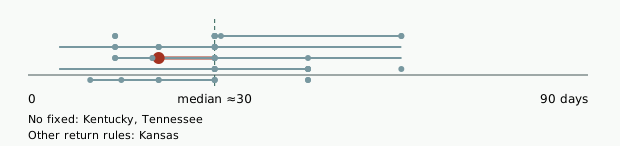
Idaho's return deadline is 21 days. The middle of the comparable state deadlines is ≈30 days. Use the dates and questions above to see which deadline applies to you.
| State | Return rule |
|---|---|
| Idaho | 21 days |
| California | 21 days |
| Connecticut | 21 days |
| Minnesota | 21 days |
| South Dakota | 21 days |
| Wisconsin | 21 days |
See all 51 jurisdictions
| State | Return rule |
|---|---|
| Montana | 10 days |
| Alaska | 14 days |
| Arizona | 14 days |
| Hawaii | 14 days |
| Kansas | 14 days |
| Nebraska | 14 days |
| New York | 14 days |
| Vermont | 14 days |
| Florida | 15 days |
| Delaware | 20 days |
| Rhode Island | 20 days |
| California | 21 days |
| Connecticut | 21 days |
| Idaho | 21 days |
| Minnesota | 21 days |
| South Dakota | 21 days |
| Wisconsin | 21 days |
| Colorado | 30 days |
| Georgia | 30 days |
| Iowa | 30 days |
| Louisiana | 30 days |
| Maine | 30 days |
| Massachusetts | 30 days |
| Michigan | 30 days |
| Missouri | 30 days |
| Nevada | 30 days |
| New Hampshire | 30 days |
| New Jersey | 30 days |
| New Mexico | 30 days |
| North Carolina | 30 days |
| North Dakota | 30 days |
| Ohio | 30 days |
| Pennsylvania | 30 days |
| South Carolina | 30 days |
| Texas | 30 days |
| Utah | 30 days |
| Washington | 30 days |
| Wyoming | 30 days |
| Oregon | 31 days |
| District of Columbia | 45 days |
| Illinois | 45 days |
| Indiana | 45 days |
| Maryland | 45 days |
| Mississippi | 45 days |
| Oklahoma | 45 days |
| Virginia | 45 days |
| Alabama | 60 days |
| Arkansas | 60 days |
| West Virginia | 60 days |
| Kentucky | No fixed return deadline |
| Tennessee | No fixed return deadline |
Source: state statute records · checked 2026-07-14 · n=48 fixed rules among 51 jurisdictions · method: first listed return deadline; calendar months plotted as ≈30 days · computed, not measured · release 5c9b10e6dffc94d70cee7a2f28ed0379eb3ce9d6
What happens if the landlord misses the deadline?
failure to return deposit as required is an actionable landlord breach under § 6-320(a)(4) after three-day written demand; court may award damages and, where violation is malicious or intentional, up to treble damages, plus costs and attorney fees per Idaho AG/Legal Aid guidance and form H-3 The statutory amount depends on the facts and any conditions in Idaho Code §§ 6-321, 6-320; it is separate from the deposit owed.
Idaho is one of 36 states where the law sets a multiple of the deposit.
| Rule | States | Share |
|---|---|---|
| The law sets a multiple of the deposit ← Idaho | 36 | 71% |
| The law names another remedy (forfeiture, fees, damages) | 10 | 20% |
| Read the cited remedy; no multiple is set | 5 | 10% |
With a deposit of $1,238 (median county rent), a claim for the deposit plus the maximum penalty is $4,952; fits under the $5,000 small claims limit.
Source: Idaho Code §§ 6-321, 6-320 · checked 2026-07-14 · n=51 · method: computed from state records · computed, not measured · release 5c9b10e6dffc94d70cee7a2f28ed0379eb3ce9d6
What do you have to do before you can claim the penalty?
Send the required information to start the clock.
- Three-day written notice listing the failure and demanding cure before filing suit (§ 6-320). Idaho Code §§ 6-321, 6-320
- Three-day written notice before filing suit (§ 6-320). Idaho Code §§ 6-321, 6-320
- Serve the three-day written notice; without it no standing to sue. Idaho Code §§ 6-321, 6-320
Does the deadline move if it falls on a weekend or holiday?
Idaho's general rule for counting legal time periods says: ... contract to be performed upon a particular day, which day falls upon a holiday, such act may be performed upon the next business day, with the same effect as if it had been performed upon the day appointed.
(Idaho Code § 73-110). Whether a court applies it to a landlord's deposit deadline depends on the case, so this page does not move the deadline for you.
To be safe: if the last day falls on a weekend or holiday, treat the deadline as passed only after the next business day. Example: October 10, 2026 is a Saturday, so wait until October 12, 2026 before saying the deadline has passed.
What Idaho law requires of the landlord
The deposit return rule is 21 calendar days (default when no return time is fixed by agreement) or 30 calendar days (outer maximum; agreement may set a time other than 21 days but may not exceed 30 days) or 3 business days (pre-suit cure: tenant must give 3 days written notice listing the failure (return of security deposit) and demand performance before filing under § 6-320; Saturdays, Sundays, and legal holidays excluded from the 3-day count per practice guides). The law also requires an itemized statement when deductions are made.
- Return window
- 21 calendar days (default when no return time is fixed by agreement) or 30 calendar days (outer maximum; agreement may set a time other than 21 days but may not exceed 30 days) or 3 business days (pre-suit cure: tenant must give 3 days written notice listing the failure (return of security deposit) and demand performance before filing under § 6-320; Saturdays, Sundays, and legal holidays excluded from the 3-day count per practice guides)
- Itemization
- Required
- Receipts threshold
- No separate threshold recorded
- Interest
- No statewide interest requirement in the verified data.
Is interest owed on a deposit in Idaho?
Idaho is one of 37 states where interest is not required by state law.
| Rule | States | Share |
|---|---|---|
| Required by state law | 3 | 6% |
| Owed only in some cases | 11 | 22% |
| Not required by state law ← Idaho | 37 | 73% |
Source: Idaho Code §§ 6-321, 6-320 · checked 2026-07-14 · n=51 · method: computed from state records · computed, not measured · release 5c9b10e6dffc94d70cee7a2f28ed0379eb3ce9d6
FAQ
How do I confirm the Idaho deadline?
Use the questions above to match your dates to Idaho Code §§ 6-321, 6-320, and keep proof of each date.
What is the small claims limit in Idaho?
See the applicable court limits and jurisdictions in the state court guide. Idaho court guide
City data on this page currently includes Boise, Meridian, Nampa, Idaho Falls, Caldwell, Pocatello, Coeur d'Alene, Twin Falls.
Statute text, sources and changes
Statute says
Upon termination of a lease or rental agreement and surrender of the premises by the tenant all amounts held by the landlord as a security deposit shall be refunded to the tenant, except amounts necessary to cover the contingencies specified in the deposit arrangement. The landlord shall not retain any part of a security deposit to cover normal wear and tear. ... Refunds shall be made within twenty-one (21) days if no time is fixed by agreement and, in any event, within thirty (30) days after surrender of the premises by the tenant. Any refunds in an amount less than the full amount deposited by the tenant shall be accompanied by a signed statement itemizing the amounts lawfully retained by the landlord, the purpose for the amounts retained, and a detailed list of expenditures made from the deposit.
What this means
Sources
- https://legislature.idaho.gov/statutesrules/idstat/Title6/T6CH3/SECT6-321/ · accessed 2026-07-14
- https://www.ag.idaho.gov/content/uploads/2025/08/LandlordTenant.pdf · accessed 2026-07-14
- https://law.justia.com/codes/idaho/title-1/chapter-23/section-1-2301/ · accessed 2026-07-14
- https://courtselfhelp.idaho.gov/Forms/Claims · accessed 2026-07-14
Changes
- : Record verified against the cited statute.
Verified 2026-07-14 · release 5c9b10e6dffc94d70cee7a2f28ed0379eb3ce9d6