Kentucky Security Deposit: Your Deadline and Next Step
Kentucky does not set a fixed number of days to return a deposit. Your landlord must send you a written notice of any refund due, and you must answer it within 60 days or you lose it.
Last checked 2026-07-14
Calculate your deadline and next letter
Your free letter
Get a DOCX letter with the dates and amount you entered.
Already sent a letter? Tell us if it worked
Details of the return rules
In Kentucky, the landlord must return the deposit within No fixed statutory deadline (landlord shall send notification of any refund due when tenant leaves not owing rent) or 30 calendar days (landlord may then remove deposit from account and apply excess to the debt owing (application-to-debt rule, not a return deadline)) or 60 calendar days (if tenant does not respond, landlord may remove and retain deposit free of tenant claims (unclaimed funds rule)).
| When it applies | Deadline | Starts from |
|---|
Kentucky return rule: No fixed statutory deadline (landlord shall send notification of any refund due when tenant leaves not owing rent). Check the dates you entered above.
Key facts
| Deadline | No fixed statutory deadline (landlord shall send notification of any refund due when tenant leaves not owing rent) (no fixed statutory number of days after move-out to return the deposit; statute requires notification of refund amount but does not set a calendar return deadline); trigger: landlord shall send notification of any refund due when tenant leaves not owing rent |
|---|---|
| Additional deadline 2 | 30 calendar days (landlord may then remove deposit from account and apply excess to the debt owing (application-to-debt rule, not a return deadline)); trigger: after the tenant leaves without paying the final month of rent and does not demand return of the deposit |
| Additional deadline 3 | 60 calendar days (if tenant does not respond, landlord may remove and retain deposit free of tenant claims (unclaimed funds rule)); trigger: after landlord sends notification of refund amount due |
| Penalty formula | landlord not entitled to retain any portion of the deposit if deposit was not held in the required separate account and initial and final damage listings were not provided |
| Bad faith required | No |
| Itemization required | Yes |
| Interest on deposit | No |
| Maximum deposit | No statewide statutory maximum under KRS 383.580. |
| Forwarding address required | No |
| Small claims limit | $2,500 (District Court small claims division (statewide)) in District Court (small claims division); damage-listing disputes also in District Court under § 383.580(5) |
| Statute citation | Ky. Rev. Stat. § 383.580 |
The landlord says you owe more than the deposit. What now?
Answer the landlord in writing and identify each disputed charge. Choose the "My landlord says I owe more" tab above. Ask for an itemized explanation and keep your response in writing.
A debt collector's notice and a credit report dispute have separate federal rules. Check whether those situations apply to you:
A debt collector's validation notice must state that the debt is assumed valid unless you dispute it within 30 days after receiving the notice. 15 U.S.C. § 1692g(a)(3): unless the consumer, within thirty days after receipt of the notice, disputes the validity of the debt, or any portion thereof, the debt will be assumed to be valid by the debt collector
If you dispute the debt in writing within that 30-day period, the collector must stop collecting the disputed part until it mails you verification. 15 U.S.C. § 1692g(b): If the consumer notifies the debt collector in writing within the thirty-day period described in subsection (a) that the debt, or any portion thereof, is disputed, or that the consumer requests the name and address of the original creditor, the debt collector shall cease collection of the debt, or any disputed portion thereof, until the debt collector obtains verification of the debt
If a disputed debt appears on your credit report, you can dispute it with the credit reporting agency, which must reinvestigate free of charge. 15 U.S.C. § 1681i(a)(1)(A): if the completeness or accuracy of any item of information contained in a consumer's file at a consumer reporting agency is disputed by the consumer and the consumer notifies the agency directly, or indirectly through a reseller, of such dispute, the agency shall, free of charge, conduct a reasonable reinvestigation
What can a landlord deduct in Kentucky?
Kentucky law names a specific rule for 0 of 6 common charges (none). For the others, the general wear-and-tear rule applies.
| Charge | Can the landlord deduct it? | Rule | Citation |
|---|---|---|---|
| Cleaning | Only if the cited general rule permits the charge | General rule: normal wear and tear cannot be charged | Ky. Rev. Stat. § 383.580 |
| Carpet replacement | Only if the cited general rule permits the charge | General rule: normal wear and tear cannot be charged | Ky. Rev. Stat. § 383.580 |
| Painting | Only if the cited general rule permits the charge | General rule: normal wear and tear cannot be charged | Ky. Rev. Stat. § 383.580 |
| Nail holes and wall damage | Only if the cited general rule permits the charge | General rule: normal wear and tear cannot be charged | Ky. Rev. Stat. § 383.580 |
| Pet damage | Only if the cited general rule permits the charge | General rule: normal wear and tear cannot be charged | Ky. Rev. Stat. § 383.580 |
| Unpaid rent and fees | Only if the cited general rule permits the charge | General rule: normal wear and tear cannot be charged | Ky. Rev. Stat. § 383.580 |
I never did a move-in inspection. How do I prove the condition?
Collect move-out photos, messages, witnesses, and repair invoices. Put them in date order before responding.
Where do you file if the letter does not work?
Small claims court in Kentucky hears claims up to $2,500. You can ask for up to $2,500 there, or file for the full amount in District Court (small claims division); damage-listing disputes also in District Court under § 383.580(5). Check the court and fees.
The state record lists a 5-year period to sue. Check when your claim accrued before counting from it.
County small claims courts
| County | Court and city | Limit | Filing fee | E-filing | Court link |
|---|---|---|---|---|---|
| Jefferson | Jefferson County District Court, Louisville | $2,500 | Statewide filing fee: Confirm current filing and service fees with the circuit court clerk. | Not verified | Official court website Court page check not recorded |
| Fayette | Fayette County District Court, Lexington | $2,500 | Statewide filing fee: Confirm current filing and service fees with the circuit court clerk. | Not verified | Official court website Court page check not recorded |
| Kenton | Kenton County District Court, Covington | $2,500 | Statewide filing fee: Confirm current filing and service fees with the circuit court clerk. | Not verified | Official court website Court page check not recorded |
See all 125 county small claims courts and filing fees
What happens if the landlord misses the deadline?
landlord not entitled to retain any portion of the deposit if deposit was not held in the required separate account and initial and final damage listings were not provided Keep statutory damages separate from the deposit and other actual damages.
Kentucky is one of 5 states where the cited remedy has no set multiple.
How does Kentucky's deadline compare with other states?
Kentucky's return deadline is No fixed return deadline. The middle of the comparable state deadlines is ≈30 days. Use the dates and questions above to see which deadline applies to you.
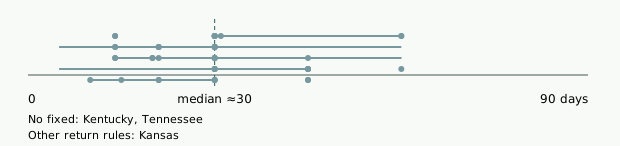
| State | Return rule |
|---|---|
| Kentucky | No fixed return deadline |
| Colorado | 30 days |
| Georgia | 30 days |
| Iowa | 30 days |
| Louisiana | 30 days |
| Maine | 30 days |
See all 51 jurisdictions
| State | Return rule |
|---|---|
| Montana | 10 days |
| Alaska | 14 days |
| Arizona | 14 days |
| Hawaii | 14 days |
| Kansas | 14 days |
| Nebraska | 14 days |
| New York | 14 days |
| Vermont | 14 days |
| Florida | 15 days |
| Delaware | 20 days |
| Rhode Island | 20 days |
| California | 21 days |
| Connecticut | 21 days |
| Idaho | 21 days |
| Minnesota | 21 days |
| South Dakota | 21 days |
| Wisconsin | 21 days |
| Colorado | 30 days |
| Georgia | 30 days |
| Iowa | 30 days |
| Louisiana | 30 days |
| Maine | 30 days |
| Massachusetts | 30 days |
| Michigan | 30 days |
| Missouri | 30 days |
| Nevada | 30 days |
| New Hampshire | 30 days |
| New Jersey | 30 days |
| New Mexico | 30 days |
| North Carolina | 30 days |
| North Dakota | 30 days |
| Ohio | 30 days |
| Pennsylvania | 30 days |
| South Carolina | 30 days |
| Texas | 30 days |
| Utah | 30 days |
| Washington | 30 days |
| Wyoming | 30 days |
| Oregon | 31 days |
| District of Columbia | 45 days |
| Illinois | 45 days |
| Indiana | 45 days |
| Maryland | 45 days |
| Mississippi | 45 days |
| Oklahoma | 45 days |
| Virginia | 45 days |
| Alabama | 60 days |
| Arkansas | 60 days |
| West Virginia | 60 days |
| Kentucky | No fixed return deadline |
| Tennessee | No fixed return deadline |
Source: state statute records · checked 2026-07-14 · n=48 fixed rules among 51 jurisdictions · method: first listed return deadline; calendar months plotted as ≈30 days · computed, not measured · release 5c9b10e6dffc94d70cee7a2f28ed0379eb3ce9d6
Local ordinances
- Louisville: Louisville Metro Landlord and Tenant Code, security depositsLouisville Metro's Landlord and Tenant Code recodifies URLTA deposit rules. Landlords must hold deposits in a separate regulated-bank account, disclose the bank and account number, give signed move-in and move-out damage lists with estimated repair costs, and forfeit the right to keep any of the deposit if those steps are skipped. There is no city cap or interest requirement and no fixed day-count to mail a refund.
- Lexington: Lexington-Fayette adoption of the Uniform Residential Landlord and Tenant ActLexington-Fayette has adopted the Uniform Residential Landlord and Tenant Act in full and without amendment, so the city's deposit rules are the URLTA separate-account, damage-list, and forfeiture scheme. There is no city cap, interest mandate, or fixed day-count to mail a refund.
- Covington: Covington Uniform Residential Landlord and Tenant Act, security depositsCovington Code Chapter 153 adopts URLTA. Section 153.28 is the city's security-deposit section. Because KRS 383.500 requires adoption without amendment, the operative rules are the separate-account, dual damage-list, and forfeiture provisions of URLTA. No city cap or interest.
- Georgetown: Georgetown adoption of the Uniform Residential Landlord and Tenant ActGeorgetown is a documented URLTA-adopting city, so residential deposits are governed by the Act's separate-account, damage-list, and forfeiture rules as city law. No city cap or interest requirement and no fixed day-count to mail a refund.
- Florence: Florence Landlord and Tenant CodeFlorence Code Chapter 97 adopts KRS 383.500 through 383.715 in their entirety. Deposit rules are therefore URLTA's separate-account, damage-list, and forfeiture scheme. No city cap or interest requirement.
FAQ
How do I confirm the Kentucky deadline?
Use the questions above to match your dates to Ky. Rev. Stat. § 383.580, and keep proof of each date.
What is the small claims limit in Kentucky?
See the applicable court limits and jurisdictions in the state court guide. Kentucky court guide
City data on this page currently includes Louisville, Lexington, Bowling Green, Owensboro, Covington, Georgetown, Richmond, Florence.
Tenant resources
- Kentucky Legal Aidlegal aid in Bowling Green, 800-782-1924
- Legal Aid of the Bluegrasslegal aid in Covington, 859-431-8200
- Legal Aid Societylegal aid in Louisville, 502-584-1254
- AppalReD Legal Aidlegal aid in Prestonsburg, 866-277-5733
- Kentucky Attorney General Office of Consumer Protectionag consumer
- Kentucky Court of Justice Legal Self-Helpcourt self help
What's next?
What to do if there is no response · How to send your letter · How to write a demand letter
Statute text, sources and changes
Statute says
In the event the tenant leaves not owing rent and having any refund due, the landlord shall send notification to the last known or reasonably determinable address, of the amount of any refund due the tenant. In the event the landlord shall not have received a response from the tenant within sixty (60) days from the sending of such notification, the landlord may remove the deposit from the account and retain it free from any claim of the tenant or any person claiming in his behalf.
What this means
Sources
- https://apps.legislature.ky.gov/law/statutes/statute.aspx?id=35733 · accessed 2026-07-14
- https://www.kyjustice.org/topics/evictions/security-deposits-only-places-passed-urlta-uniform-residential-landlord-tenant-act · accessed 2026-07-14
- https://www.kycourts.gov/Legal-Help/Documents/P-6_Small_Claims_Handbook.pdf · accessed 2026-07-14
Changes
- : Record verified against the cited statute.
Verified 2026-07-14 · release 5c9b10e6dffc94d70cee7a2f28ed0379eb3ce9d6