Free Texas Security Deposit Demand Letter
30 days
In Texas, your landlord has 30 days to return your deposit or send an itemized list (Tex. Prop. Code §§92.101-92.109).
Checked against the statute on .
Money kept for cleaning or repairs? Check the deduction rules.
Count your deadline
Your deadline counts from the later of the day you moved out or the day you gave your landlord your new address in writing. Without that written address, the clock does not start. Enter your dates, and we show the exact day.
Waiting for your deposit? Use the first tab. Got a notice that the landlord is keeping money? Use the second.
Money kept for cleaning or repairs? Check the deduction rules. If nothing is demanded beyond your deposit, enter zero below.
- Return deadline: 30 days if For leases signed or renewed on or after 2025-09-01, notices may go by email if the parties have communicated by email before (HB 2037). The 30 days are unchanged; the tenant must still give a written forwarding address.
Independent site. Not affiliated with any court or government agency.
Ready when you are
Your free Texas demand letter
It cites Tex. Prop. Code §§92.101-92.109 and asks for your deposit by a set date. Copy it, print it, or download it as a Word file. No email needed.
Count your deadline above, and the letter fills in your dates and amounts.
- Calculation: After you count your deadline, we fill in: dates, deadline, amount.
- You: Your name and addresses, landlord name and address, lease dates. Add the dates you returned the keys and gave your forwarding address, your response date and any enclosures.
Before you send: filling in the blanks
- Fill in every [bracket]. Keep only statements that are true for you. Choose a date for your requested response, then delete this box before sending the letter.
- Attach copies of what you have: your lease, move-out photos, proof of your forwarding address, and receipts. Keep the originals.
- Send by certified mail with return receipt requested, and keep a copy.
- Where to file in Texas if the landlord does not respond: Justice Court (Justice of the Peace). See Tex. Prop. Code §§92.101-92.109 (Subchapter C) for penalties that may apply.
- Self-help legal information only. This template is not legal advice and does not create an attorney-client relationship.
- Give the landlord your forwarding address in writing before using this letter, and keep proof that you did.
- If "For leases signed or renewed on or after 2025-09-01, notices may go by email if the parties have communicated by email before (HB 2037). The 30 days are unchanged; the tenant must still give a written forwarding address.": the deadline is 30 days after the date the tenant surrenders the premises. Use this in the letter.
[Your full name]
[Your forwarding address]
[Phone or email]
[Date]
Sent by certified mail, return receipt requested
[Landlord or property manager name]
[Landlord address]
RE: Demand for return of security deposit, [rental property address] (Tex. Prop. Code §§92.101-92.109)
Dear [Landlord name]:
I rented [rental property address] from [lease start date] to [move-out date]. I paid a security deposit of $[amount]. I returned the keys on [date] and gave you my forwarding address in writing on [date].
Under Texas law (Tex. Prop. Code §§92.101-92.109), a landlord must return the deposit or respond in writing within [applicable deadline: 30 days] after the date the tenant surrenders the premises. [That deadline has passed, and] I have not received [my deposit / a written response].
Please send the withheld balance of $[withheld] to my forwarding address above by [response date]. Please include an itemized statement and receipts for any deductions.
If I do not receive it by that date, I plan to file a claim in small claims court, and I will ask the court for the deposit and any additional amounts the law allows.
I would prefer to settle this without going to court.
Sincerely,
[Signature]
[Your name]
Enclosures: [list what you attach]
Send it yourself
- Fill in the remaining blanks. Print two copies and sign both. Keep one.
- Send by Certified Mail with Return Receipt, about $11.02 at the post office. USPS prices.
- Keep the mailing receipt and delivery record with your copy.
- Wait until the response date you put in your letter.
Email me this letter and a few tips on what to do if my landlord does not answer.
If your landlord does not answer
How we check this page
4 official sources, each linked below: the statute and state government pages.
Statute checked: October 18, 2026.
Every legal number on this page comes from the quoted statute text.
Read the statute, sources and change log
Statute text
Sec. 92.103. OBLIGATION TO REFUND. (a) Except as provided by Section 92.107, the landlord shall refund a security deposit to the tenant on or before the 30th day after the date the tenant surrenders the premises. ... Sec. 92.109. LIABILITY OF LANDLORD. (a) A landlord who in bad faith retains a security deposit in violation of this subchapter is liable for an amount equal to the sum of $100, three times the portion of the deposit wrongfully withheld, and the tenant's reasonable attorney's fees in a suit to recover the deposit.
Sources
- Tex. Prop. Code §§92.101-92.109 (Subchapter C)
- guides.sll.texas.gov: source reference
- capitol.texas.gov: source reference
- Tex. Gov't Code § 311.014
Change log
- : rollover: added the time-computation rule and the statute quote.
- : Deposit claim limit: added so the court page can say whether a deposit claim fits the small-claims limit.
- : deadlines: added detail under HB 2037.
See an error? Tell us, and we recheck the source.
All legal facts and deadlines
Key facts
| Deadline | 30 days (For leases signed or renewed on or after 2025-09-01, notices may go by email if the parties have communicated by email before (HB 2037). The 30 days are unchanged; the tenant must still give a written forwarding address.) |
|---|---|
| Deadline trigger | the date the tenant surrenders the premises (possession) |
| Penalty formula | $100 + 3x the portion wrongfully withheld + reasonable attorney's fees when landlord acts in bad faith; bad faith is presumed if landlord fails to refund or itemize within 30 days (Tex. Prop. Code §92.109) |
| Bad faith required | Yes |
| Itemization required | Yes |
| Interest on deposit | No |
| Maximum deposit | No statutory limit on residential security deposits in Texas |
| Forwarding address required | Yes |
| Small claims limit | $20,000statewide in Justice Court (Justice of the Peace) |
| Statute citation | Tex. Prop. Code §§92.101-92.109 (Subchapter C) |
Deductions, disputes and going to small claims
The landlord says you owe more than the deposit. What now?
Answer the landlord in writing and identify each disputed charge. Choose the "My landlord says I owe more" tab above. Ask for an itemized explanation and keep your response in writing.
A debt collector's notice and a credit report dispute have separate federal rules. Check whether those situations apply to you:
A debt collector's validation notice must state that the debt is assumed valid unless you dispute it within 30 days after receiving the notice. 15 U.S.C. § 1692g(a)(3): unless the consumer, within thirty days after receipt of the notice, disputes the validity of the debt, or any portion thereof, the debt will be assumed to be valid by the debt collector
If you dispute the debt in writing within that 30-day period, the collector must stop collecting the disputed part until it mails you verification. 15 U.S.C. § 1692g(b): If the consumer notifies the debt collector in writing within the thirty-day period described in subsection (a) that the debt, or any portion thereof, is disputed, or that the consumer requests the name and address of the original creditor, the debt collector shall cease collection of the debt, or any disputed portion thereof, until the debt collector obtains verification of the debt
If a disputed debt appears on your credit report, you can dispute it with the credit reporting agency, which must reinvestigate free of charge. 15 U.S.C. § 1681i(a)(1)(A): if the completeness or accuracy of any item of information contained in a consumer's file at a consumer reporting agency is disputed by the consumer and the consumer notifies the agency directly, or indirectly through a reseller, of such dispute, the agency shall, free of charge, conduct a reasonable reinvestigation
What can a landlord deduct in Texas?
Texas law names a specific rule for 4 of 6 common charges (cleaning, carpet replacement, painting and unpaid rent and fees). For the others, the general wear-and-tear rule applies.
| Charge | Can the landlord deduct it? | Rule | Citation |
|---|---|---|---|
| Cleaning | Only if this condition is met: The landlord may not retain any portion of a security deposit to cover normal wear and tear. | Allowed only as damages or charges for which the tenant is legally liable under the lease or as a result of breaching the lease; the… | Tex. Prop. Code § 92.104(a)-(b) |
| Carpet replacement | Only if the conditions in the cited rule are met | Deductible only as tenant-caused damage (negligence, carelessness, accident, or abuse), not as normal wear and tear. No statutory useful-life or depreciation schedule. | Tex. Prop. Code §§ 92.001(4), 92.104(a)-(b) |
| Painting | Only if the conditions in the cited rule are met | Deductible only as tenant-caused damage beyond normal wear and tear. Faded paint and ordinary scuffing fall within the statutory definition of normal wear and tear.… | Tex. Prop. Code §§ 92.001(4), 92.104(b) |
| Nail holes and wall damage | Only if the cited general rule permits the charge | General rule: normal wear and tear cannot be charged | Tex. Prop. Code §§ 92.001(4), 92.104(b) |
| Pet damage | Only if the cited general rule permits the charge | General rule: normal wear and tear cannot be charged | Tex. Prop. Code §§92.101-92.109 (Subchapter C) |
| Unpaid rent and fees | Yes | Before returning a security deposit, the landlord may deduct damages and charges for which the tenant is legally liable under the lease or as a… | Tex. Prop. Code § 92.104(a) |
I never did a move-in inspection. How do I prove the condition?
Collect move-out photos, messages, witnesses, and repair invoices. Put them in date order before responding.
Where do you file if the letter does not work?
Small claims court in Texas hears claims up to $20,000. You can ask for up to $20,000 there, or file for the full amount in Justice Court (Justice of the Peace). Check the court and fees.
The state record lists a 4-year period to sue. Check when your claim accrued before counting from it.
County small claims courts
| County | Court and city | Limit | Filing fee | E-filing | Court link |
|---|---|---|---|---|---|
| Harris County | Justice of the Peace (JP) Court, Precinct Civil Division - Small Claims Case, Houston | $20,000 (statewide) | County filing fee: $54 base filing fee (plus separate service-of-process fee, ~$75) | Yes | Official court website Court page check not recorded |
| Dallas County | Justice of the Peace Court (multiple precincts) - Small Claims, Dallas | $20,000 (statewide) | County filing fee: $54 filing fee only, or ~$134 all-in (varies by precinct; +$80 per additional defendant) | Yes | Official court website Court page check not recorded |
| Tarrant County | Justice of the Peace Court (Precinct courts) - Small Claims Case, Fort Worth | $20,000 (statewide) | County filing fee: $54 filing fee + ~$90 constable service fee per party served | Yes | Official court website Court page check not recorded |
See all 254 county small claims courts and filing fees
What happens if the landlord misses the deadline?
$100 + 3x the portion wrongfully withheld + reasonable attorney's fees when landlord acts in bad faith; bad faith is presumed if landlord fails to refund or itemize within 30 days (Tex. Prop. Code §92.109) Keep statutory damages separate from the deposit and other actual damages.
Texas is one of 36 states where the law sets a multiple of the deposit.
With a deposit of $1,475 (median county rent), a claim for the deposit plus the maximum penalty is $5,900; fits under the $20,000 small claims limit.
How this state compares with the other states
How does Texas's deadline compare with other states?
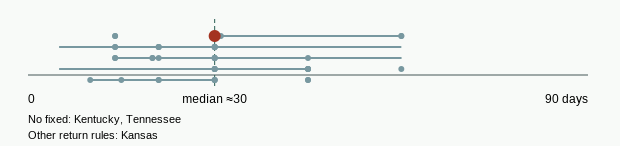
Texas's return deadline is 30 days. The middle of the comparable state deadlines is ≈30 days. Use the dates and questions above to see which deadline applies to you.
| State | Return rule |
|---|---|
| Texas | 30 days |
| Colorado | 30 days |
| Georgia | 30 days |
| Iowa | 30 days |
| Louisiana | 30 days |
| Maine | 30 days |
See all 51 jurisdictions
| State | Return rule |
|---|---|
| Montana | 10 days |
| Alaska | 14 days |
| Arizona | 14 days |
| Hawaii | 14 days |
| Kansas | 14 days |
| Nebraska | 14 days |
| New York | 14 days |
| Vermont | 14 days |
| Florida | 15 days |
| Delaware | 20 days |
| Rhode Island | 20 days |
| California | 21 days |
| Connecticut | 21 days |
| Idaho | 21 days |
| Minnesota | 21 days |
| South Dakota | 21 days |
| Wisconsin | 21 days |
| Colorado | 30 days |
| Georgia | 30 days |
| Iowa | 30 days |
| Louisiana | 30 days |
| Maine | 30 days |
| Massachusetts | 30 days |
| Michigan | 30 days |
| Missouri | 30 days |
| Nevada | 30 days |
| New Hampshire | 30 days |
| New Jersey | 30 days |
| New Mexico | 30 days |
| North Carolina | 30 days |
| North Dakota | 30 days |
| Ohio | 30 days |
| Pennsylvania | 30 days |
| South Carolina | 30 days |
| Texas | 30 days |
| Utah | 30 days |
| Washington | 30 days |
| Wyoming | 30 days |
| Oregon | 31 days |
| District of Columbia | 45 days |
| Illinois | 45 days |
| Indiana | 45 days |
| Maryland | 45 days |
| Mississippi | 45 days |
| Oklahoma | 45 days |
| Virginia | 45 days |
| Alabama | 60 days |
| Arkansas | 60 days |
| West Virginia | 60 days |
| Kentucky | No fixed return deadline |
| Tennessee | No fixed return deadline |
Source: state statute records · checked 2026-10-18 · n=48 fixed rules among 51 jurisdictions · method: first listed return deadline; calendar months plotted as ≈30 days · computed, not measured · release 9bc606745cf41f96d1bf92d676bb74ab21820d72
Frequently asked questions
FAQ
Does Houston have its own security deposit law?
No separate city security-deposit ordinance is listed in the verified data. Check the applicable Texas law.
Does San Antonio have its own security deposit law?
No separate city security-deposit ordinance is listed in the verified data. Check the applicable Texas law.
Does Dallas have its own security deposit law?
No separate city security-deposit ordinance is listed in the verified data. Check the applicable Texas law.
Does Fort Worth have its own security deposit law?
No separate city security-deposit ordinance is listed in the verified data. Check the applicable Texas law.
What is the small claims limit in Texas?
See the applicable court limits and jurisdictions in the state court guide. Texas small claims courts and filing fees
Can I use this if I do not know the exact deposit amount?
Use the amount shown in your lease, receipt, or move-in records. If records conflict, keep copies and avoid guessing in the letter.
Should I send evidence with the first letter?
Attach copies when they prove the basic facts, such as payment, move-out condition, forwarding address, or prior messages.
Can this page replace legal advice?
No. This page is self-help information for organizing a demand letter and checking the cited data before you act.
City data on this page currently includes Houston, San Antonio, Dallas, Fort Worth, Austin, El Paso, Arlington, Corpus Christi, Plano, Lubbock, Laredo, Irving, Garland, Frisco, McKinney.
Tenant resources
- TexasLawHelp.org (a program of Texas Legal Services Center)legal aid
- Texas RioGrande Legal Aid (TRLA)legal aid in Weslaco (serves 68 counties in central/southwest Texas), (956) 996-8752
- Texas Tenants' Uniontenant union in Dallas, (214) 823-2733
- Texas Attorney General Consumer Protection Hotlineag consumer, (800) 621-0508
What's next?
What to do if there is no response · How to send your letter · How to write a demand letter